Mahjong Tasty Pairs: How to Play
A practical walkthrough written for this specific game.
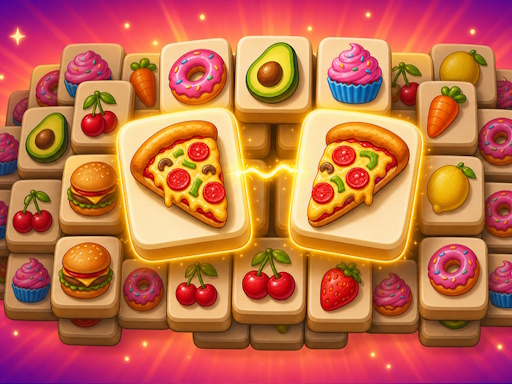
Mahjong Tasty Pairs is a food-themed mahjong solitaire game with three hundred procedurally arranged stages. Identical open tiles are removed in pairs; a tile is available only when nothing covers it and at least one side edge is free. Stars, leaderboard results, hints, undo, and shuffle support increasingly dense layouts.
Remove upper layers first
Pairs that expose several covered tiles provide more value than isolated edge matches. Look for pieces whose removal opens the centre.
Protect duplicate availability
If four identical tiles are visible, consider which pairing frees the most future moves. Removing the wrong two can leave the others blocked.
Scan systematically
Search from top layer to bottom and left to right. Random scanning repeatedly checks the same food icons and misses available pairs.
Use undo as information
Undo the last pair when it closes useful options. Remember what the board revealed and try the alternative pairing.
Shuffle and hints
Request a hint when a legal pair is genuinely hard to see. Shuffle when no productive sequence remains, not merely because the preferred pair is blocked.
A clearing routine
- Identify the highest exposed tiles.
- Find pairs that open the centre.
- Preserve alternate copies.
- Clear long stacks before isolated edges.
- Undo harmful pairing choices.
- Use shuffle only after checking all open sides.
Controls
Select two identical open tiles. A tile is open when uncovered from above and not blocked on both side edges. Use displayed Hint, Undo, and Shuffle controls.
Questions
Why is a matching tile dim?
It is covered or blocked on both sides and cannot yet be selected.
Which pair comes first?
Prefer the pair that exposes the greatest number of new tiles.
Mahjong Tasty Pairs rewards forward planning. Clear the layers that unlock information, preserve duplicate choices, and treat every food pair as a decision about the remaining board.
Quick controls
Clear three hundred food-themed mahjong layouts by pairing identical open tiles, exposing layered pieces, and using hints, undo, or shuffle carefully.